Physics · Electricity · 3e, 2nde
Ohm’s law and resistance
A power supply, a wire, two meters. Vary the voltage, change the wire’s length and diameter, and rediscover the relationship between voltage, current and resistance yourself.
- 2D
- HTML5
- 0.1 MB
- Offline
- Phone
- 20 to 30 min
 Launch the simulation
What you will explore
- Measure voltage and current across a conducting wire.
- Show that U and I are proportional, and name the constant.
- See how length, diameter and metal change the resistance.
- Plot U against I and read the slope.
Concepts
- Voltage
- Current
- Resistance
- Ohm’s law
- Resistivity
- Graph
The 3 simulation screens
- 1Explore
- 2Measure
- 3Graph
Exploration prompts
- To beginDouble the voltage. What happens to the current? And if you halve it?
- To investigateSame voltage, a wire twice as long: does the current rise or fall? Explain in your own words.
- To go furtherFind two different settings that give the same resistance.
Self-assessment: 5 questions, 10 minutesFor BEFREE Academy accounts: your answers and measurements are saved there, and the “Ohm’s law” badge is awarded on success.
Sign inWhat Ohm’s law says
Across an ohmic conductor, the voltage U (in volts) and the current I flowing through it (in amperes) are proportional:
U = R × I
The constant R is the conductor’s resistance, in ohms (Ω). It does not depend on the applied voltage: double U and I doubles too, so the ratio U / I stays the same.
Where a wire’s resistance comes from
For a uniform wire of length L and cross-section S:
R = ρ × L / S
- ρ (rho) is the metal’s resistivity: very low for copper and aluminium, higher for iron, much higher for heating alloys (nichrome).
- A wire twice as long has twice the resistance.
- A wire with twice the diameter has four times the cross-section, hence a quarter of the resistance.
Reading a U = f(I) graph
Plot the measured (I, U) pairs: the points line up on a straight line through the origin. Its slope is the resistance: the steeper the line, the larger R. This is the surest way to check that a component follows Ohm’s law.
What the simulation leaves out
A real wire heats up as current flows, and its resistance rises slightly with temperature. The simulation keeps the temperature constant to isolate Ohm’s law; tell students it is a simplification.
Equipment (in the simulation)
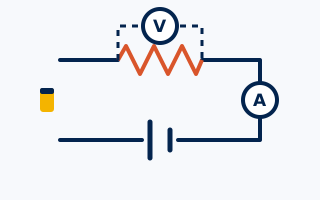
An adjustable power supply, a conducting wire whose metal, length and diameter you choose, a voltmeter across the wire, an ammeter in series.
Steps
- Set the wire: copper, 10 cm, 0.2 mm diameter. Set the voltage to 2 V.
- Read U and I on the meters, then press Record measurement: the row is added to the notebook.
- Repeat for 4 V, 6 V, 8 V. Each time, work out U / I in your head before reading R.
- Change the length (20 cm, then 30 cm) at fixed voltage: what happens to the current?
- Change the diameter (0.4 mm): compare with the 0.2 mm wire.
- Change the metal, everything else equal: rank the metals from best to worst conductor.
- Open the Graph screen: check that your points line up, and read the slope.
What to write down
For each measurement: the wire (metal, length, diameter), U, I and R = U / I. The notebook does it for you; you can export it as CSV or, with a BEFREE Academy account, save it.
Common pitfalls
- Reading the current in milliamps and the voltage in volts, then mixing units in the calculation.
- Comparing two wires after changing two parameters at once: change one thing only between two measurements.
Self-assessment: 5 questions, 10 minutesFor BEFREE Academy accounts: your answers and measurements are saved there, and the “Ohm’s law” badge is awarded on success.
Sign inWhere it fits
After measuring voltages and currents in a series circuit, before electrical power. One 45-minute session is enough: 10 minutes of free exploration, 25 minutes of protocol, 10 minutes of pooling results.
Suggested sequence
- On the board (projector or shared phone): launch the simulation, ask “what will the current do if I double the voltage?”, then check.
- In pairs, on phones: follow the protocol and fill in the measurement notebook.
- Pooling: each pair gives its slope; compare values, discuss the differences (reading, rounding).
- Written record: Ohm’s law, the wire resistance formula, a graph.
Without a network
After a first load, the simulation stays available offline on the device that opened it. For a room without a connection, open the simulation on each phone the day before, or download the archive when the page offers one.
Assessment
With a BEFREE Academy account, students answer five questions after the session; the teacher sees the results in BEFREE Academy. Without an account, the three exploration prompts on the page work as oral questions.
To be provided by the team
[Printable activity sheet (PDF) and answer key: to be written and uploaded, then set “ficheEnseignant” in the simulations file.]
Sample content: it will be replaced by the association’s real content.
Related simulations
All simulations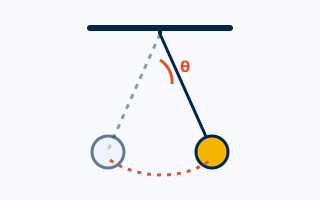 Coming soon
- 2D
- 0.8 MB
The simple pendulum
Length, mass, amplitude: what changes the period?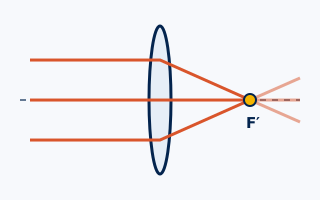 Coming soon
- 2D
- 0.6 MB
Converging lenses
Move the object, find the image, read the focal length. Coming soon
- 3D
- 3.4 MB